Key learnings list from a Strategic Storytelling Session
Anjali Sharma
Director of Narrative
Published Date
June 14, 2022
I am writing this blog to capture the key learnings I shared in a session I conducted for a large platform company. If you were in attendance in the session, you will understand the context to these key learnings and if you are a regular blog reader, then also you can learn a few good storytelling tips here.
Key Learnings List1. The difference between Inspire and Influence
To inspire with stories is different to influence with stories. Inspire means to fill (someone) with the urge or ability to do or feel something, especially to do something creative. Influence means the capacity to have an effect on the character or behaviour of someone or something. One of the ways I decide whether I tell inspirational stories which leverage character and emotion or tell influential stories which leverages analysis is by asking myself the following question
The action that I want people to take effects ( the effect can be positive or negative ) who? Just the person taking the action or many more people? If it is just the person taking the action then inspirational storytelling is my choice and if the action taken effects many people then influential storytelling is my choice. That is why you see a lot of inspirational storytelling on stage and influential storytelling in boardrooms.
2. An Effective Corporate Storyteller
To be an effective corporate storyteller who can make a change happen you need to learn five different styles of storytelling . I covered two of those in this session
Journalistic style, where you go and find stories to form a point of view and support a point of view.
Marketer style, where you build connections by understanding the worldviews of the audience you seek to serve.
There are two stories I told in the session. One of the story was of Andre Pole, you can listen that story in this video which is of the talk I gave at Braze, Forge Connections Conference in New York. The story is at 3.24 time marker of the video here
The other story I told was of Nora Ephron, you can listen to the story here
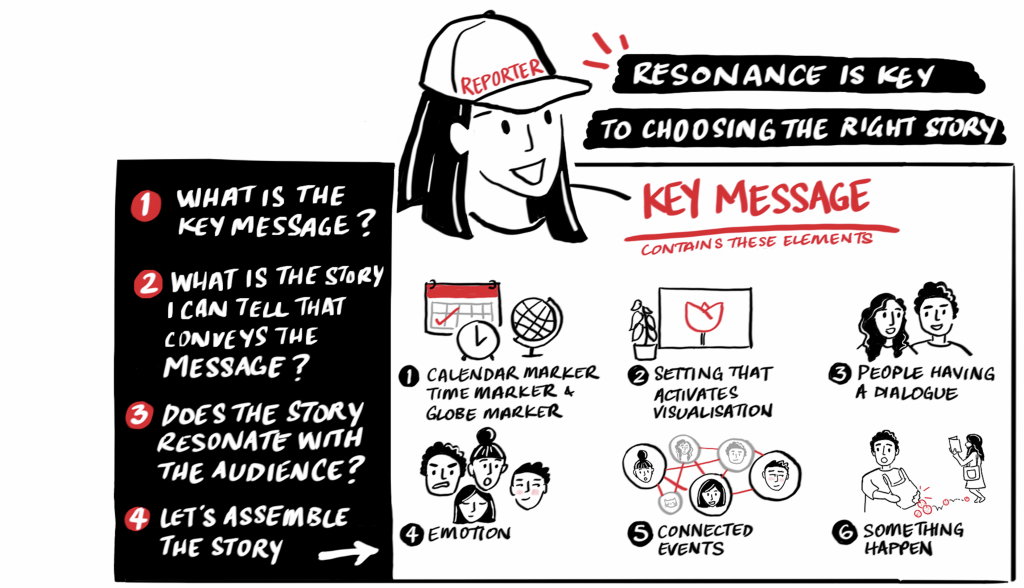
3 The figure below captures the Story Process.
4. People Chase Identities
Always think of the identities people chase. People don't chase goals they chase identities, make sure you have that in your stories for your audience.
Here is my Forbes Article that makes this point: Click Here
5.How to Elicit Stories
If you really want to know what is going on don't ask for people's opinion, ask them to share a moment and give examples.
6. Start your Presentations with TPRA
A good opening line to a presentation can be formed with a combination of TPRA where T is time, P is the point you are making, R is the result you want to draw and A is the action
When you build stories for leadership, cross check the proposition your story makes. If it makes a proposition in either one of the three categories, you will be successful with the story
T is time : We will save time
I is image : We will have a better image or reputation
M is money : We will save for make money
Here is a blog that I have written in the past which elaborates this point : Click Here
Book Update
If you are not new here you would know that my upcoming boom Strategic Storytelling published by The Hachette Book Group is launching in Nov 2022 in UK and Mar 2023 in US. We are planing on a few events leading up to the book launch. Please do sign up here if you would like to be the first to know.
This article explores why storytelling is often misunderstood, why trusted advisors need more than logic alone, and how organizations can move from competing on price and execution to competing on insight and value.
Creating content for attention is easy. Creating content that builds lasting affinity is much harder. In this blog, I reflect on the difference between short-form and long-form content, why enduring work compounds over time, and what writing a book taught me about credibility, trust, and meaningful impact.
This article explores how resonance and unexpected moments make leadership storytelling more engaging, using a real transformation project called “Da Vinci” as an example.