Their slides are filled with information, so much information that it feels to me like a Slideument (Slide + Document).
When asked, "Why do you have so much information on a slide that you are presenting?", their response was, "It's a template that I have to follow." Clearly, this person has fallen victim to the template and is no longer fulfilling the original purpose of a presentation.
Purpose of a presentation is to make the change happen via transfer of emotions.
If you are a victim to a template as well, I request that you to understand some things first.
Ask yourself, what is my communication mechanism?
Is it a live presentation or a document I have to email?
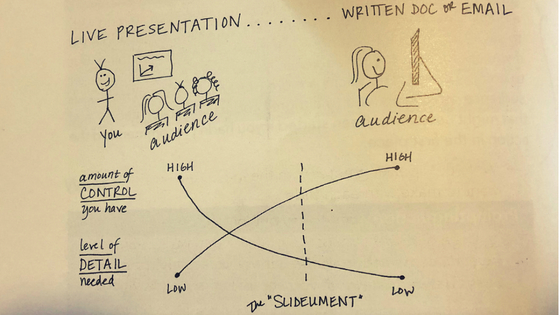
The method that you will use to communicate to your audience should determine how your slides look. Let's look at this figure below.
When presenting live (on the left of the figure), you have a lot of control over your presentation, and the level of detail you need to add to your slides can be low because you, as the subject matter expert, is there to answer any questions asked.
Whereas, when you are sending a document (on the right of the figure), you do not have much control and the level of detail has to be high.
Templates designed to provide a lot of information cater to the later scenario, when you are not there.
In an ideal world, we would have two different documents:
1. For live presentations
2. For emailing
But time constraints often put us in a situation where we just create one document (referred to as The Slideument in the figure above) and in the process, fall victim to the template, tarnish our personal brand, do not influence decisions and do not make the change happen.
Source: Figure: Cole Nussbaumer Knaflic's book, Storytelling With Data.
This article explores why storytelling is often misunderstood, why trusted advisors need more than logic alone, and how organizations can move from competing on price and execution to competing on insight and value.
Creating content for attention is easy. Creating content that builds lasting affinity is much harder. In this blog, I reflect on the difference between short-form and long-form content, why enduring work compounds over time, and what writing a book taught me about credibility, trust, and meaningful impact.
This article explores how resonance and unexpected moments make leadership storytelling more engaging, using a real transformation project called “Da Vinci” as an example.